
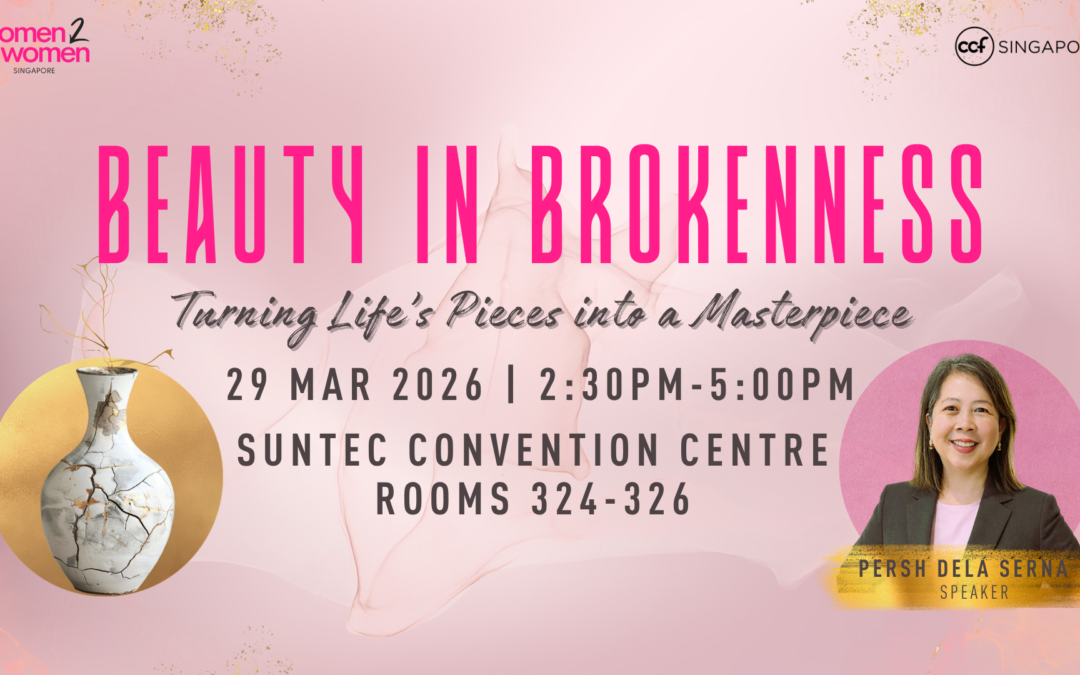
March 29, 2026 | Sis Persh Dela Serna
Women2Women talk on “Beauty in Brokenness” by Sister Persh explains that everyone experiences some form of brokenness, yet in God’s hands those shattered pieces can become a meaningful masterpiece. Sis Persh begins by contrasting a perfect white vase with a cracked bowl to show how we often feel pressure to look “perfect” while hiding inner fractures such as failure, loss, or shame. Using images of a cracked heirloom bowl, Japanese kintsugi (mending with gold), she argues that God does not throw away broken lives but repairs and reuses them, often making them more beautiful and valuable than before. She then names the “anatomy of brokenness” – academic pressure, body image struggles, “no love life,” mental health battles, financial burdens, bullying, difficult employers, broken relationships, aging, career stagnation, loneliness etc.
To ground the theme biblically, Sis Persh focuses on the story of Naomi and Ruth from the Book of Ruth in the Old Testament, beginning with Ruth 1:1: “In the days when the judges ruled, there was a famine in the land.” This verse sets the context of spiritual and physical hardship in which the story unfolds. Famine forces Naomi’s family to leave Bethlehem for Moab, an enemy land, where her husband and two sons die, leaving Naomi and her daughters‑in‑law widowed and destitute. Naomi urges Orpah and Ruth to return to their families; Orpah eventually leaves, but Ruth clings to Naomi and declares the words of Ruth 1:16 in paraphrase, “Your people will be my people and your God my God,” forsaking her Moabite identity and gods to follow Naomi’s God. When they return to Bethlehem, Naomi, whose name means “pleasant,” tells the women to call her “Mara” (“bitter”) because she went away full but came back empty, a picture of someone whose losses seem to define her entire identity. Ruth then goes to glean leftover grain in the fields and “happens” to end up in the field of Boaz, a relative of Naomi’s late husband; Sis Persh highlights that what looks like coincidence is actually God quietly orchestrating events.
Boaz protects and provides for Ruth generously, instructing his workers to leave extra grain for her and sending her home with six measures of barley so she will not go home empty‑handed, signalling that God is beginning to reverse Naomi’s emptiness. Naomi then guides Ruth in a bold step: Ruth goes to Boaz at night on the threshing floor and asks him to “take me under your wing” (Ruth 3:9), invoking refuge and the legal role of a kinsman‑redeemer so that Naomi’s family line might continue. Boaz settles the matter by approaching a closer male relative who declines the responsibility, then formally takes Ruth as his wife, and God blesses their union with a son so that Naomi, once bitter and “empty,” now holds a baby in her arms as the community declares that Ruth is better to her than seven sons.
In the second part, Sis Persh shares her own testimony of brokenness. She describes family displacement during political upheaval, financial insecurity, and other disruptions that marked her childhood and left deep but often unspoken fears. She recounts the death of her mother from liver cancer when she was a young teen: receiving the news at the hospital, crying alone in a bathroom, and later sitting in front of her mother’s clothes, realizing she would never see her again. That loss triggered a profound fear of death and questions about the meaning of life. She carried religious objects, prayed rosaries, and tried various devotions in search of security but remained anxious and uncertain how to be sure of heaven. Over time, she became troubled by the idea that only those with certain religious practices or objects would be saved, feeling it would be “unfair” if salvation depended on rituals that many around the world did not even know.
To illustrate the seriousness of eternity, Sis Persh uses a long rope in which a tiny pink segment represents a human lifespan and the rest symbolizes endless eternity. She asks what happens after that short earthly portion and points out that everyone will eventually be forgotten on earth; the crucial question is not how long we are remembered but where our souls will spend eternity—heaven or hell. A university friend later shares the Christian gospel with her, asking what she thinks will happen after death and explaining that human efforts to reach God always fall short because all people are sinners. Sis Persh highlights John 3:16—that God loved the world and gave His only Son so that everyone who believes in Him will not perish but have eternal life—and John 5:24, where Jesus promises that those who hear His message and believe in the One who sent Him have eternal life and have already crossed from death to life. She stresses that we are “already judged” if we reject God’s Son, but that receiving eternal life is not about performing many religious acts; it centers on one response: believing in Jesus Christ as Savior who died in our place. When her friend asks whether she believes, her initial “maybe” is challenged—there is no “maybe,” only yes or no—showing that each of us must personally decide to trust Christ instead of remaining in vague, uncertain belief.
Throughout the talk, Sis Persh returns to the image of the broken bowl and kintsugi. We may feel like useless shards or quietly carry hidden names like “Mara,” yet God does not discard us; He patiently mends and repurposes our pain, sometimes over many years. She urges us—especially if we feel academically, relationally, financially, emotionally, or spiritually broken, or simply “broke”—to see that God can use even those fractures to strengthen us, bless others, and draw us to Himself. In light of Ruth’s story—especially Ruth 1:1, Ruth’s declaration in Ruth 1:16, and her plea in Ruth 3:9—and her own journey, Sis Persh invites us to examine our relationship with Christ and consider where we will spend eternity, trusting that God can turn life’s broken pieces into His masterpiece.